


HRCI Research
Stay Informed

Lead with Data

The HRCI Research Hub brings together original studies, workforce polling, reports, and expert analysis, so you can act on what's happening now and prepare for what's next.

The State of HR Featured Reports
Featured Research

Managing the Changing Workplace: A Framework for HR

From return-to-office decisions and hybrid work to contractors and other non-traditional workers, this HRCI report explores the latest research and how HR can use data to make more informed, evidence-based workplace decisions.

Remote working conference call
Did You Know?
59%
Workplace Relationship Policies
say their company does not enforce policies prohibiting romantic relationships between employees
Source: HRCI Alchemizing HR poll, January 2025
89%
Leadership Overreach
say leaders take on problems that should belong to someone else
Source: HRCI Alchemizing HR webinar poll, April 2026
55%
Political Discussions at Work
of HR professionals are somewhat, minimally, or not at all prepared to handle politically-charged discussions at work
Source: HRCI Report — Managing Political Polarization in the Workplace, 2025
Recent Reports

Original research and expert analysis on the issues shaping HR today, from workforce safety and emerging technology to DEI and employee well-being.

The Secret Ingredients of Workplace Fulfillment

From career paths to culture, this research identifies what actually separates HR professionals who are just getting by from those who are truly fulfilled—and what leaders can do to close that gap and build a more committed team.

The Vital Role of Professional Development

This research uncovers where professional development is falling short, from misaligned training priorities to gaps in AI readiness, and what it takes to build a workforce equipped for what's next.

Small Conflicts Don't Stay Small

From bullying, political tension to substance use and violence prevention, this research covers workplace safety—what the data reveals, what's at stake, and what you can do to reduce risk and build a more resilient organization.

Extreme Weather and the Workplace

From rising absenteeism to safety risks, HRCI research reveals how extreme weather is reshaping workforce management and what HR can do now.

The State of HR

The 2026 State of HR Report

Based on HRCI’s survey of thousands of HR professionals, the State of HR report examines the issues defining the profession today. From AI and workplace culture to talent, leadership, and career growth, the report reveals how HR teams are adapting to change and preparing for the future. Explore the data, trends, and insights shaping the world of work below.

Download the Full Report

State of HR Spotlight Reports

Safety, Polarization, and Stress

Half of HR professionals work in environments marked by polarized viewpoints, and 4 in 10 describe their stress as extreme or high. Find out what the data reveals about conflict, mental health, and what it means for your organization.

HR Professionals and Their Outlook for HR

HR professionals are broadly optimistic about their field — but over 4 in 10 are considering careers outside of it. Explore what's driving both the enthusiasm and the tension, and what it takes to build a team of true HR believers.

HR Professionals and Technological Change

71% of HR professionals use AI regularly, yet more than half say implementing new technology is the area they feel least prepared to handle. See where the preparation gap is widest and what needs to change now.

Attitudes Toward Remote Work

83% of HR professionals believe remote work benefits organizations—but the debate is far from settled. Get the data on where HR stands on flexibility, productivity, and the return-to-office conversation.

Professionals Problem Solving

More Insights for HR Professionals

Explore the issues shaping HR today and get the data you need to lead with confidence, make informed decisions, and move the profession forward.

Recovery friendly workplaces reduce absenteeism, improve retention, and strengthen workplace culture—yet most organizations haven't made meaningful progress. This HRCI and Fors Marsh research reveals why: stigma, undertrained HR teams, and weak leadership buy-in top the list. Understand where the gaps are and what organizations that get it right do differently. 

Earning an HRCI certification builds earning power. Within four years, the median HRCI certificant earns 33% more than they did before getting certified. That's double the salary growth of comparable HR professionals over the same period. See what the data shows about the career and financial impact of HRCI certification. 

HR is ready to lead, but is the organization ready to let it? This 2024 HRCI and MindEdge research report surfaces a striking disconnect: while 88% of HR professionals believe HR should drive business strategy, only half say leadership agrees. Add in underfunding, understaffing, and persistent burnout, and the case for rethinking HR's role has never been stronger. 

AI is reshaping the workplace, and HR professionals are watching closely. This HRCI and MindEdge survey of HR practitioners reveals how the profession is navigating AI adoption, persistent burnout, rising turnover, and the evolving push and pull of remote work. Find out where your peers stand, and what the data means for the work you do every day. 


Research Archive

Browse our complete library of research reports, guides, and frameworks. Whether you're building a business case, navigating a workforce challenge, or staying ahead of what's next, the intelligence you need is here.
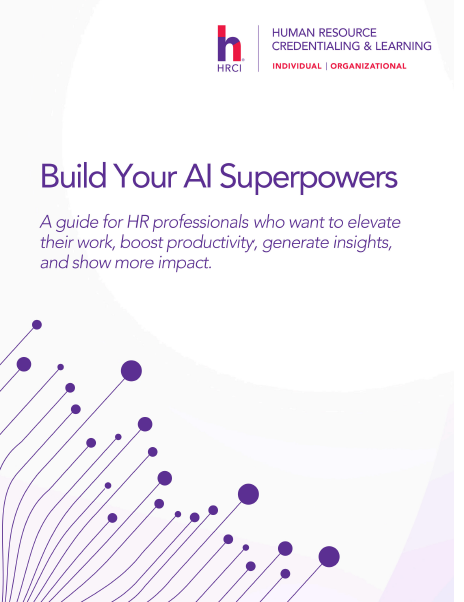
 

Ai Superpower
Strengthening AI Skills in HR

Over three-quarters of HR professionals use AI weekly, but most have had little to no training. Learn how to build real confidence and capability starting today.
Empowering the Intelligent Workplace

Explore how HR can turn AI adoption into a strategic advantage—balancing innovation with ethical responsibility.
Becoming Recovery-Friendly

This research-backed guide gives HR professionals the data and practical steps to build a recovery-friendly culture that reduces risk and supports your people.
Diversity Initiatives in 2025

The report explores the realities of managing DEI programs in today’s climate—where values alignment, stakeholder trust, and business performance are all on the line.
Managing Political Polarization in the Workplace

This report provides critical insights and actionable strategies for HR leaders to foster a more harmonious and productive work environment. 

Webinar online learning

Beyond the Data

HRCI webinars go beyond the basics. Each session unpacks the trends, data, and real-world strategies HR professionals need to lead with confidence today and adapt to what's coming next.


HR Leads Business Blog

News and perspectives on the issues driving the HR profession forward.

Apr 7, 2026, 16:02 PM by Neil Reichenberg, HRCI Contributing Writer

DEI Executive Order for Federal Contractors Released

A new DEI executive order for federal contractors, proposed DOL rules on retirement investments and H-1B wages, and NLRB leadership changes signal shifting policy priorities for HR.
President Trump issued an executive order concerning diversity, equity, and inclusion discrimination by federal contractors. The Department of Labor published proposed rules concerning the inclusion of alternative investment investments in 401(k) plans and increasing the prevailing wages paid to H-1B and other visa recipients. James Murphy has been designated as the chairman of the National Labor Relations Board (NLRB).
 
Federal Contractor DEI Executive Order Issued – President Trump issued an executive order,
“Addressing DEI Discrimination by Federal Contractors.” The executive order states that it is the policy to prevent racial discrimination in contracting. Racially discriminatory diversity, equity, and inclusion (DEI) activities are defined as “disparate treatment based on race or ethnicity in the recruitment, employment (e.g., hiring, promotions), contracting (e.g. vendor agreements), program participation or allocation or deployment of an entity’s resources.”
 
Federal agencies have 30 days to ensure that contractors and subcontractors certify that they will not engage in any racially discriminatory DEI activities, will provide all requested information and reports to assure compliance, and will report any violations of the executive order by subcontractors. Any violation may result in the cancellation, termination, or suspension of the contract, and the barring of the contractor or subcontractor from future government contracts.
 
On January 20, 2025, Trump issued executive order 14151, “Ending Radical and Wasteful Government DEI Programs and Preferencing” that directed federal agencies to review and revise existing federal employment practices, union contracts, and training policies to eliminate consideration of DEI “factors, goals, policies, mandates, or requirements.” The executive order required federal agencies to terminate all DEI offices and positions, all equity plans, actions, initiatives, grants, contracts, and all DEI performance requirements for employees, contractors, or grantees.
 
Proposed Regulation Authorizes Alternative Investments in Retirement Accounts – The Employee Benefits Security Administration of the Department of Labor (DOL) issued a proposed rule, “Fiduciary Duties in Selecting Designated Investment Alternatives.” Comments on the proposed rule are due by June 1, 2026. The goal of the proposed regulation is to reduce regulatory burdens and the risk of litigation under the Employee Retirement Security Act of 1974 (ERISA) that may interfere with “the ability of American workers to achieve, through their retirement accounts, the competitive returns and asset diversification necessary to secure a dignified and comfortable retirement.”
 
The proposed regulation would clarify that fiduciaries have the discretion to determine when alternative investments should be included as retirement account options.  Secretary of Labor Lori Chavez-DeRemer stated, “This proposed rule will show how plans can consider products that better reflect the investment landscape as it exists today.”
 
The proposed regulation is in follow-up to executive order 14330, “Democratizing Access to Alternative Assets for 401(k) Investors” signed by President Trump on August 12, 2025, that calls for expanding investment opportunities in retirement plans. The executive order set forth alternative investment options that should be offered in 401(k) plans that include private market investments, real estate interests, digital assets, commodities, infrastructure products, and lifetime income investment strategies. 
 
DOL Proposes Increase to H-1B Wage Rates – The Employment and Training Administration of the Department of Labor (DOL) proposed a rule, “Improving Wage Protections for the Temporary and Permanent Employment of Certain Foreign Nationals in the United States.” Comments on the proposed rule are due by May 26, 2026. The proposed rule would update the percentages derived from the Bureau of Labor Statistics’ Occupational Employment and Wage Statistics survey to align wages paid under the H-1B and other programs with those paid to American workers in similar occupations. Secretary of Labor Lori Chavez-DeRemer stated, “This proposed rule will help ensure that employers pay foreign workers wages that reflect the real market value of their labor, in addition to protecting the wages and job opportunities of American workers.”
 
The law requires employers who want to hire temporary foreign workers through the H-1B and other programs to pay them the higher of the prevailing wage for the area of intended employment or the actual wage rate paid to similarly qualified American workers in the area of intended employment. According to DOL, the changes made by the proposed rule would “improve the correlation between wages paid to foreign workers and those paid to American workers with similar skills and qualifications, reduce the economic incentives to underpay foreign workers and undermine the American workforce, and promote fair competition in the American labor market.”
 
The DOL believes the existing prevailing wage levels have been set below the market rates that are paid to many American workers, especially for entry-level and recent college graduates in STEM fields. The wage survey uses a four-tier structure designed to recognize increasing experience levels with level 1 for entry, level 2 for qualified, level 3 for experienced, and level 4 for fully competent.  The current percentile levels of the prevailing wage from the Occupational Employment and Wage Statistics survey that must be paid under the proposed rule would increase as follows:
 
Level 1 – from 17th percentile to the 34th percentile
Level 2 – from 34th percentile to the 52nd percentile
Level 3 – from the 50th percentile to the 70th percentile
Level 4 – from the 67th percentile to the 88th percentile
 
The proposed rule would apply only prospectively to applications pending on the effective date of the rule.
 

James Murphy Named NLRB Chairman – President Trump designated National Labor Relations Board (NLRB) member James R. Murphy as the NLRB chairman. He was sworn in as an NLRB member on January 7, 2026, for a term expiring on December 16, 2027. He returned to the NLRB where he previously worked for 47 years. He stated that he was looking forward to working with “all NLRB employees to protect and advance the rights of American workers.”


Neil Reichenberg is the former executive director of the International Public Management Association for Human Resources. He is an attorney, a frequent writer and speaker on public policy and human resource issues, and an adjunct faculty member at George Mason University. For questions or additional information, contact Reichenberg at neilreichenberg@yahoo.com.