


The HRCI Research Hub brings together original studies, workforce polling, reports, and expert analysis, so you can act on what's happening now and prepare for what's next.
The State of HR Featured ReportsManaging the Changing Workplace: A Framework for HR
From return-to-office decisions and hybrid work to contractors and other non-traditional workers, this HRCI report explores the latest research and how HR can use data to make more informed, evidence-based workplace decisions.

Original research and expert analysis on the issues shaping HR today, from workforce safety and emerging technology to DEI and employee well-being.
From career paths to culture, this research identifies what actually separates HR professionals who are just getting by from those who are truly fulfilled—and what leaders can do to close that gap and build a more committed team.
This research uncovers where professional development is falling short, from misaligned training priorities to gaps in AI readiness, and what it takes to build a workforce equipped for what's next.
From bullying, political tension to substance use and violence prevention, this research covers workplace safety—what the data reveals, what's at stake, and what you can do to reduce risk and build a more resilient organization.
From rising absenteeism to safety risks, HRCI research reveals how extreme weather is reshaping workforce management and what HR can do now.
The State of HR
Based on HRCI’s survey of thousands of HR professionals, the State of HR report examines the issues defining the profession today. From AI and workplace culture to talent, leadership, and career growth, the report reveals how HR teams are adapting to change and preparing for the future. Explore the data, trends, and insights shaping the world of work below.
Download the Full ReportState of HR Spotlight Reports
Half of HR professionals work in environments marked by polarized viewpoints, and 4 in 10 describe their stress as extreme or high. Find out what the data reveals about conflict, mental health, and what it means for your organization.
HR professionals are broadly optimistic about their field — but over 4 in 10 are considering careers outside of it. Explore what's driving both the enthusiasm and the tension, and what it takes to build a team of true HR believers.
71% of HR professionals use AI regularly, yet more than half say implementing new technology is the area they feel least prepared to handle. See where the preparation gap is widest and what needs to change now.
83% of HR professionals believe remote work benefits organizations—but the debate is far from settled. Get the data on where HR stands on flexibility, productivity, and the return-to-office conversation.

More Insights for HR Professionals
Explore the issues shaping HR today and get the data you need to lead with confidence, make informed decisions, and move the profession forward.
Recovery friendly workplaces reduce absenteeism, improve retention, and strengthen workplace culture—yet most organizations haven't made meaningful progress. This HRCI and Fors Marsh research reveals why: stigma, undertrained HR teams, and weak leadership buy-in top the list. Understand where the gaps are and what organizations that get it right do differently.
Earning an HRCI certification builds earning power. Within four years, the median HRCI certificant earns 33% more than they did before getting certified. That's double the salary growth of comparable HR professionals over the same period. See what the data shows about the career and financial impact of HRCI certification.
HR is ready to lead, but is the organization ready to let it? This 2024 HRCI and MindEdge research report surfaces a striking disconnect: while 88% of HR professionals believe HR should drive business strategy, only half say leadership agrees. Add in underfunding, understaffing, and persistent burnout, and the case for rethinking HR's role has never been stronger.
AI is reshaping the workplace, and HR professionals are watching closely. This HRCI and MindEdge survey of HR practitioners reveals how the profession is navigating AI adoption, persistent burnout, rising turnover, and the evolving push and pull of remote work. Find out where your peers stand, and what the data means for the work you do every day.
Browse our complete library of research reports, guides, and frameworks. Whether you're building a business case, navigating a workforce challenge, or staying ahead of what's next, the intelligence you need is here.
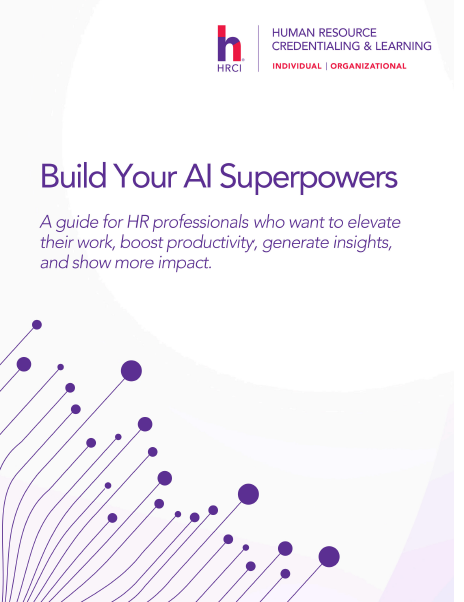
Over three-quarters of HR professionals use AI weekly, but most have had little to no training. Learn how to build real confidence and capability starting today.
Explore how HR can turn AI adoption into a strategic advantage—balancing innovation with ethical responsibility.
This research-backed guide gives HR professionals the data and practical steps to build a recovery-friendly culture that reduces risk and supports your people.
The report explores the realities of managing DEI programs in today’s climate—where values alignment, stakeholder trust, and business performance are all on the line.
This report provides critical insights and actionable strategies for HR leaders to foster a more harmonious and productive work environment.

HRCI webinars go beyond the basics. Each session unpacks the trends, data, and real-world strategies HR professionals need to lead with confidence today and adapt to what's coming next.
News and perspectives on the issues driving the HR profession forward.
Artificial intelligence has already made its way into the day-to-day work of HR. HRCI research shows that more than three quarters of HR professionals use AI regularly, while nearly 60% report little or no training. Many professionals are using it to draft communications, summarize policies, or generate reports, often through tools embedded directly into the systems they use every day. Adoption is no longer the primary challenge.
What is less developed is the capability behind that usage. Across the profession, there is a noticeable gap between how often AI is used and how confidently it is applied. Many HR professionals report limited formal training, and usage tends to be inconsistent, experimental, or narrowly focused on basic tasks. That gap is becoming more important as expectations around AI continue evolving.
The conversation around AI in HR has shifted quickly. Early discussions focused on access: which tools to use, where to find them, and what they could do. Today, access is far less of a barrier.
The more pressing question is how effectively those tools are being used in real work.
Capability is not about becoming a technical expert. It is about developing fluency and judgment. HR professionals need to understand where AI can add value, where it introduces risk, and how to integrate it into workflows to improve outcomes rather than simply increasing activity.
Many are navigating that learning curve largely on their own. HRCI data indicates that roughly 63% of HR professionals have limited organizational support when it comes to learning and adopting AI.
This distinction matters because AI can produce output quickly, but speed alone does not ensure quality. Without a clear understanding of how to guide and evaluate that output, efficiency gains can come at the expense of accuracy, consistency, or trust.
For most HR professionals, developing AI capability is a gradual process rather than a single step. It often begins with drafting emails, summarizing documents, or rewriting content. These are useful entry points and often the first exposure to what AI can do.
Over time, usage becomes more integrated. AI is used regularly within workflows, not just for isolated tasks. Professionals begin to refine outputs through follow-up prompts, compare responses, and apply judgment more deliberately.
As confidence grows, the scope of use expands. AI is applied to more complex work, including analyzing information, identifying patterns, or supporting decision-making. At this stage, the value of AI is less about saving time on individual tasks and more about improving the overall quality and depth of work.
Progression depends on consistent use and a willingness to move beyond basic applications.
One of the more effective ways to build that capability is to rethink how AI is used within the workday. Rather than treating it as a tool for specific tasks, approach it as a resource that supports thinking and refinement throughout the process. This often means using AI in moments where a colleague might normally be consulted.
Questions such as “Does this approach make sense?” “What am I overlooking?” or “How could this be improved?” can be worked into an ongoing workflow. This tends to produce stronger results over time because it encourages iteration and engagement rather than one-time output generation.
As AI becomes more embedded in HR work, the need for discipline becomes more important. AI-generated content can appear polished and complete, even when it contains inaccuracies or incomplete reasoning. It can also reflect bias or draw from sources that are not appropriate for professional use. For that reason, outputs should always be reviewed and validated before use in a workplace context.
Data privacy and organizational policy are also important considerations. Sensitive or proprietary information should not be entered into AI tools without clear approval, and existing guidelines should always be followed.
According to HRCI’s 2026 State of HR report, more than half of HR professionals say their organization offers no AI training at all. In that environment, responsible use depends on individual awareness and judgment. more than half of HR professionals say their organization offers no AI training at all. In that environment, responsible use depends on individual awareness and judgment.
This is where HR’s role becomes even more important. It includes modeling responsible use and reinforcing standards that protect both the organization and its employees.
Many organizations are still developing their approach to AI. Training programs, governance structures, and internal policies are evolving but not yet fully established in many workplaces.
That creates an opportunity for HR practitioners who take a more active approach to capability development to be better prepared to contribute to their workplace’s AI policy efforts. They will be in a stronger position to evaluate tools, guide adoption, and participate in decisions that shape how AI is used across the organization.
At the same time, expectations are shifting. As AI becomes more common, a baseline level of fluency will increasingly be expected.
For those looking to move beyond initial experimentation, the most effective next step is to approach AI development with intention.
That includes using AI regularly, expanding the types of tasks it supports, and taking the time to evaluate and refine outputs rather than accepting them at face value. Over time, this leads to greater confidence and a clearer understanding of where AI can contribute meaningfully.
To support that process, HRCI developed Build Your AI Superpowers, a practical guide designed to help HR professionals strengthen their approach to AI and apply it in a way that aligns with professional standards.
As AI continues to shape how work gets done, capability will become just as important as access. Developing that capability now positions HR professionals to contribute more effectively and to lead with greater confidence as expectations change.