


HRCI Research
Stay Informed

Lead with Data

The HRCI Research Hub brings together original studies, workforce polling, reports, and expert analysis, so you can act on what's happening now and prepare for what's next.

The State of HR Featured Reports
Featured Research

Managing the Changing Workplace: A Framework for HR

From return-to-office decisions and hybrid work to contractors and other non-traditional workers, this HRCI report explores the latest research and how HR can use data to make more informed, evidence-based workplace decisions.

Remote working conference call
Did You Know?
59%
Workplace Relationship Policies
say their company does not enforce policies prohibiting romantic relationships between employees
Source: HRCI Alchemizing HR poll, January 2025
89%
Leadership Overreach
say leaders take on problems that should belong to someone else
Source: HRCI Alchemizing HR webinar poll, April 2026
55%
Political Discussions at Work
of HR professionals are somewhat, minimally, or not at all prepared to handle politically-charged discussions at work
Source: HRCI Report — Managing Political Polarization in the Workplace, 2025
Recent Reports

Original research and expert analysis on the issues shaping HR today, from workforce safety and emerging technology to DEI and employee well-being.

The Secret Ingredients of Workplace Fulfillment

From career paths to culture, this research identifies what actually separates HR professionals who are just getting by from those who are truly fulfilled—and what leaders can do to close that gap and build a more committed team.

The Vital Role of Professional Development

This research uncovers where professional development is falling short, from misaligned training priorities to gaps in AI readiness, and what it takes to build a workforce equipped for what's next.

Small Conflicts Don't Stay Small

From bullying, political tension to substance use and violence prevention, this research covers workplace safety—what the data reveals, what's at stake, and what you can do to reduce risk and build a more resilient organization.

Extreme Weather and the Workplace

From rising absenteeism to safety risks, HRCI research reveals how extreme weather is reshaping workforce management and what HR can do now.

The State of HR

The 2026 State of HR Report

Based on HRCI’s survey of thousands of HR professionals, the State of HR report examines the issues defining the profession today. From AI and workplace culture to talent, leadership, and career growth, the report reveals how HR teams are adapting to change and preparing for the future. Explore the data, trends, and insights shaping the world of work below.

Download the Full Report

State of HR Spotlight Reports

Safety, Polarization, and Stress

Half of HR professionals work in environments marked by polarized viewpoints, and 4 in 10 describe their stress as extreme or high. Find out what the data reveals about conflict, mental health, and what it means for your organization.

HR Professionals and Their Outlook for HR

HR professionals are broadly optimistic about their field — but over 4 in 10 are considering careers outside of it. Explore what's driving both the enthusiasm and the tension, and what it takes to build a team of true HR believers.

HR Professionals and Technological Change

71% of HR professionals use AI regularly, yet more than half say implementing new technology is the area they feel least prepared to handle. See where the preparation gap is widest and what needs to change now.

Attitudes Toward Remote Work

83% of HR professionals believe remote work benefits organizations—but the debate is far from settled. Get the data on where HR stands on flexibility, productivity, and the return-to-office conversation.

Professionals Problem Solving

More Insights for HR Professionals

Explore the issues shaping HR today and get the data you need to lead with confidence, make informed decisions, and move the profession forward.

Recovery friendly workplaces reduce absenteeism, improve retention, and strengthen workplace culture—yet most organizations haven't made meaningful progress. This HRCI and Fors Marsh research reveals why: stigma, undertrained HR teams, and weak leadership buy-in top the list. Understand where the gaps are and what organizations that get it right do differently. 

Earning an HRCI certification builds earning power. Within four years, the median HRCI certificant earns 33% more than they did before getting certified. That's double the salary growth of comparable HR professionals over the same period. See what the data shows about the career and financial impact of HRCI certification. 

HR is ready to lead, but is the organization ready to let it? This 2024 HRCI and MindEdge research report surfaces a striking disconnect: while 88% of HR professionals believe HR should drive business strategy, only half say leadership agrees. Add in underfunding, understaffing, and persistent burnout, and the case for rethinking HR's role has never been stronger. 

AI is reshaping the workplace, and HR professionals are watching closely. This HRCI and MindEdge survey of HR practitioners reveals how the profession is navigating AI adoption, persistent burnout, rising turnover, and the evolving push and pull of remote work. Find out where your peers stand, and what the data means for the work you do every day. 


Research Archive

Browse our complete library of research reports, guides, and frameworks. Whether you're building a business case, navigating a workforce challenge, or staying ahead of what's next, the intelligence you need is here.
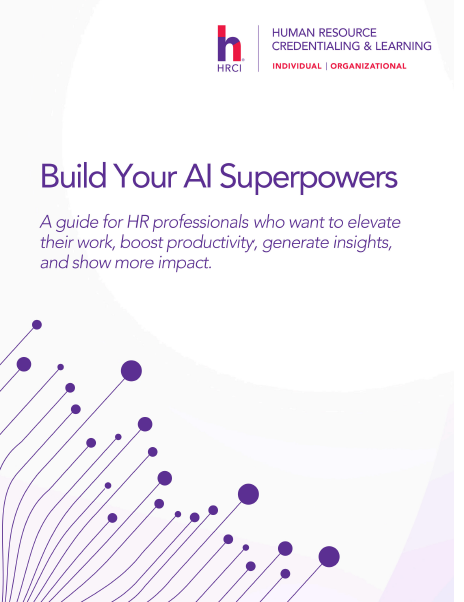
 

Ai Superpower
Strengthening AI Skills in HR

Over three-quarters of HR professionals use AI weekly, but most have had little to no training. Learn how to build real confidence and capability starting today.
Empowering the Intelligent Workplace

Explore how HR can turn AI adoption into a strategic advantage—balancing innovation with ethical responsibility.
Becoming Recovery-Friendly

This research-backed guide gives HR professionals the data and practical steps to build a recovery-friendly culture that reduces risk and supports your people.
Diversity Initiatives in 2025

The report explores the realities of managing DEI programs in today’s climate—where values alignment, stakeholder trust, and business performance are all on the line.
Managing Political Polarization in the Workplace

This report provides critical insights and actionable strategies for HR leaders to foster a more harmonious and productive work environment. 

Webinar online learning

Beyond the Data

HRCI webinars go beyond the basics. Each session unpacks the trends, data, and real-world strategies HR professionals need to lead with confidence today and adapt to what's coming next.


HR Leads Business Blog

News and perspectives on the issues driving the HR profession forward.

Oct 7, 2025, 18:09 PM by Neil Reichenberg, HRCI Contributing Writer

Labor Department Releases Joint Employment Opinion Letter

The DOL’s new opinion letter clarifies when related employers are joint employers for FLSA overtime—and jointly liable. We also break down significant H-1B policy moves and enforcement, WHD’s electronic-only payments beginning Oct. 1, and OSHA’s guidance letters for employers.
The Department of Labor issued an opinion letter finding that employees who work for employers who are connected may be entitled to overtime under the Fair Labor Standards Act (FLSA). There have been several updates issued by the Trump Administration concerning the H-1B visa. Effective October 1st, the Wage and Hour Division will only accept electronic payments. The Occupational Safety and Health Administration provides interpretive letters designed to provide guidance to employers.

DOL Issues Joint Employment Opinion Letter – The Wage and Hour Division of the Department of Labor (DOL) issued a wage-hour opinion letter concerning joint employment under the Fair Labor Standards Act (FLSA).  Opinion letters represent the position of DOL on the issues raised by those requesting the letters. The opinion letter 2025-05, noted that horizontal joint employment may occur where employers “are sufficiently associated with respect to the employment of the particular employee(s).” Where horizontal joint employment exists, the total number of hours worked by an employee in a workweek must be added together and each employer is “jointly and severally liable for any wages owed under the FLSA.

An employee who works at a restaurant was offered shifts at a membership club, both of which are located in a hotel. The employee was told that the same rate of pay would be provided for any work done at the club. While the entities have separate business structures, they share a kitchen, offer similar food and beverages, operate under similar trade names. and have common ownership. Several employees perform work for both entities in the same workweek. 

If the employee who requested the letter worked at both the restaurant and club, the number of hours worked in a week would exceed 40 hours. The employee was told that overtime would not be provided since these were separate entities. The Wage and Hour Division concluded “that all of the hours that you work each workweek at the restaurant and the members club must be combined for the purposes of FLSA compliance, and that you should be paid the overtime premium in accordance with the FLSA for hours worked over 40 in a workweek.”

H-1B Visa Update – The Trump Administration has increased the fee for those individuals seeking to obtain an H-1B visa to $100,000 from $2,000 to $5,000. The new fee applies prospectively to those visa petitions filed starting on September 21, 2025. The H-1B visa allows employers to bring highly educated professionals to work temporarily in the United States in specialty occupations. The jobs require at least a bachelor’s degree or equivalent. There is a cap of 65,000 H-1B visas per year, with an additional 20,000 visas for those who graduate with a master’s degree or doctorate from a U.S. college. According to the Department of Homeland Security (DHS), the H-1B visa was created by Congress to “help U.S. employers obtain the temporary employees they need to meet their business needs to remain competitive in the global economy.” The cap on the number of visas issued annually was designed to address the concern that “a surplus of foreign labor could depress wages for all workers in the long run.”

DHS also issued a proposed regulation changing the selection process for the H-1B visa. The proposed regulation would modify the process from a random selection to one that is weighted based on the wages to be paid and would favor the allocation of the visas to higher skilled and higher paid individuals. Four wage levels would be created based on the wages that a beneficiary would receive. The higher the wages, the more entries that would be provided in the selection pool. Wage level 1 would receive one entry into the selection pool, wage level 2 would receive two entries, wage level 3 would receive 3 entries, and wage level 4 would receive 4 entries. Comments on the proposed regulation are due by October 24, 2025.

The Department of Labor (DOL) launched Project Firewall, which is an H-1B visa enforcement initiative designed to ensure that employers give priority to qualified Americans when hiring workers and that employers are held accountable for abuses of the H-1B visa process. The goal of the program according to Secretary of Labor Lori Chavez-DeRemer is to “ensure that highly skilled jobs go to Americans first.” 

DOL intends to undertake investigations of employers to maximize H-1B visa program compliance. The Secretary of Labor for the first time will certify the initiation of investigations. According to DOL,  where violations are discovered, back wages, civil monetary penalties, and/or debarment from future use of the H-1B program for a specific amount of time could result.  DOL’s Office of Immigration Policy, Employment and Training Administration, and Wage and Hour Division will lead this effort in collaboration with other federal agencies including the Civil Rights Division of the Department of Justice, the Equal Employment Opportunity Commission, and U.S. Citizenship and Immigration Services. The Wage and Hour Division provides H-1B visa compliance assistance resources for employers. 

Wage Hour Division Will Only Accept Electronic Payments – The Wage and Hour Division (WHD) of the Department of Labor (DOL) announced that effective October 1st, it will only accept electronic payments from employers that are sent via www.pay.gov. On March 25th, President Trump issued Executive Order 14247, Modernizing Payments to and From America’s Bank Account that set a September 30th deadline for the federal government to switch to electronic payments and disbursements. Back wages and liquidated damages will only be paid beginning October 1st through the Department of Treasury’s Digital Pay or Treasury’s US Debit Card program.

OSHA Provides Letters of Interpretation – The Occupational Safety and Health Administration (OSHA) issues letters of interpretation that provide OHSA’s interpretation of its statute, standards, and regulations. The letters are designed to assist employers to comply with OSHA requirements and are posted on OSHA’s website. Information about how to request a letter is also available.  

Neil Reichenberg is the former executive director of the International Public Management Association for Human Resources. He is an attorney, a frequent writer and speaker on public policy and human resource issues, and an adjunct faculty member at George Mason University. For questions or additional information, contact Reichenberg at neilreichenberg@yahoo.com.