


The HRCI Research Hub brings together original studies, workforce polling, reports, and expert analysis, so you can act on what's happening now and prepare for what's next.
The State of HR Featured ReportsManaging the Changing Workplace: A Framework for HR
From return-to-office decisions and hybrid work to contractors and other non-traditional workers, this HRCI report explores the latest research and how HR can use data to make more informed, evidence-based workplace decisions.

Original research and expert analysis on the issues shaping HR today, from workforce safety and emerging technology to DEI and employee well-being.
From career paths to culture, this research identifies what actually separates HR professionals who are just getting by from those who are truly fulfilled—and what leaders can do to close that gap and build a more committed team.
This research uncovers where professional development is falling short, from misaligned training priorities to gaps in AI readiness, and what it takes to build a workforce equipped for what's next.
From bullying, political tension to substance use and violence prevention, this research covers workplace safety—what the data reveals, what's at stake, and what you can do to reduce risk and build a more resilient organization.
From rising absenteeism to safety risks, HRCI research reveals how extreme weather is reshaping workforce management and what HR can do now.
The State of HR
Based on HRCI’s survey of thousands of HR professionals, the State of HR report examines the issues defining the profession today. From AI and workplace culture to talent, leadership, and career growth, the report reveals how HR teams are adapting to change and preparing for the future. Explore the data, trends, and insights shaping the world of work below.
Download the Full ReportState of HR Spotlight Reports
Half of HR professionals work in environments marked by polarized viewpoints, and 4 in 10 describe their stress as extreme or high. Find out what the data reveals about conflict, mental health, and what it means for your organization.
HR professionals are broadly optimistic about their field — but over 4 in 10 are considering careers outside of it. Explore what's driving both the enthusiasm and the tension, and what it takes to build a team of true HR believers.
71% of HR professionals use AI regularly, yet more than half say implementing new technology is the area they feel least prepared to handle. See where the preparation gap is widest and what needs to change now.
83% of HR professionals believe remote work benefits organizations—but the debate is far from settled. Get the data on where HR stands on flexibility, productivity, and the return-to-office conversation.

More Insights for HR Professionals
Explore the issues shaping HR today and get the data you need to lead with confidence, make informed decisions, and move the profession forward.
Recovery friendly workplaces reduce absenteeism, improve retention, and strengthen workplace culture—yet most organizations haven't made meaningful progress. This HRCI and Fors Marsh research reveals why: stigma, undertrained HR teams, and weak leadership buy-in top the list. Understand where the gaps are and what organizations that get it right do differently.
Earning an HRCI certification builds earning power. Within four years, the median HRCI certificant earns 33% more than they did before getting certified. That's double the salary growth of comparable HR professionals over the same period. See what the data shows about the career and financial impact of HRCI certification.
HR is ready to lead, but is the organization ready to let it? This 2024 HRCI and MindEdge research report surfaces a striking disconnect: while 88% of HR professionals believe HR should drive business strategy, only half say leadership agrees. Add in underfunding, understaffing, and persistent burnout, and the case for rethinking HR's role has never been stronger.
AI is reshaping the workplace, and HR professionals are watching closely. This HRCI and MindEdge survey of HR practitioners reveals how the profession is navigating AI adoption, persistent burnout, rising turnover, and the evolving push and pull of remote work. Find out where your peers stand, and what the data means for the work you do every day.
Browse our complete library of research reports, guides, and frameworks. Whether you're building a business case, navigating a workforce challenge, or staying ahead of what's next, the intelligence you need is here.
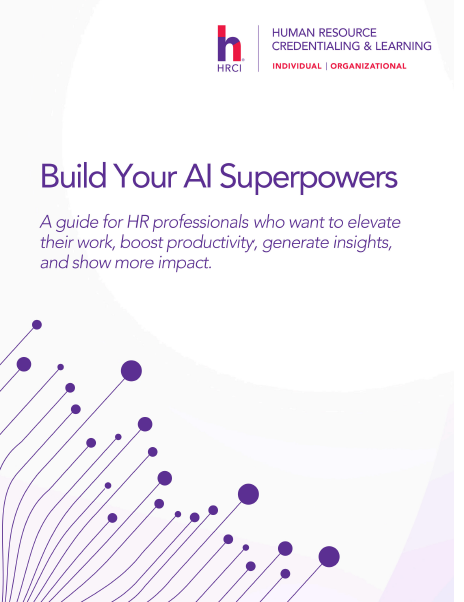
Over three-quarters of HR professionals use AI weekly, but most have had little to no training. Learn how to build real confidence and capability starting today.
Explore how HR can turn AI adoption into a strategic advantage—balancing innovation with ethical responsibility.
This research-backed guide gives HR professionals the data and practical steps to build a recovery-friendly culture that reduces risk and supports your people.
The report explores the realities of managing DEI programs in today’s climate—where values alignment, stakeholder trust, and business performance are all on the line.
This report provides critical insights and actionable strategies for HR leaders to foster a more harmonious and productive work environment.

HRCI webinars go beyond the basics. Each session unpacks the trends, data, and real-world strategies HR professionals need to lead with confidence today and adapt to what's coming next.
News and perspectives on the issues driving the HR profession forward.
The Department of Homeland Security issued guidance advising employers using E-Verify that employment authorization document revocations will no longer appear in the case alerts. The Labor Department announced that it will no longer seek liquidated damages in any FLSA pre-litigation investigation or resolution. A bipartisan bill was introduced in the Senate that would reduce the participation age from 21 to 18 for defined contributions plans that are covered by ERISA. The Labor Department released the Veterans Accommodations Toolkit, which is designed to be a resource for increasing the employment and participation in apprenticeship programs of disabled American veterans.
DHS Issues Employment Authorization Document Guidance for E-Verify Employers – The Department of Homeland Security (DHS) has issued guidance advising employers using the E-Verify system that employment authorization document (EAD) revocations will no longer appear in the case alerts. Employers are directed to “generate the Status Change Report to identify E-Verify cases that may have been created with an EAD that is now revoked.” The notice indicated that to access the status change report, employers should log in to their E-Verify accounts, click on the Reports tab at the top of the page to select the new Status Change Report.
If a current employee appears on the Status Change Report, the employer should determine if there is a need to reverify the employment authorization for the employee. If the numbers on the employee’s EAD card match the one on the Status Change Report, the employment authorization must be reverified. The reverification can be done using Form I-9, Supplement B and should be completed “within a reasonable amount of time.” DHS cautions that the Status Change report “does not replace an employer’s legal requirement to verify employment eligibility for their employees in accordance with the Form I-9 process.”
DOL Will No Longer Seek Liquidated Damages in FLSA Administrative Matters – The Department of Labor (DOL) advised in Field Assistance Bulletin (FAB) 2025-3 that the Wage and Hour Division (WHD) will not seek the payment of liquidated damages in any pre-litigation investigation or resolution brought under the Fair Labor Standards Act (FLSA). The DOL believes that Section 216(c) of the FLSA only authorizes the WHD to “supervise the payment of the unpaid minimum wages or the unpaid overtime compensation owing to any employee.” Liquidated damages can only be sought, according to the DOL, where an enforcement action results in litigation. The new policy became effective on June 27, 2025.
The FAB rescinds FAB 2021-2. The DOL noted that prior to 2010, the WHD did not seek liquidated damages in the administrative investigation stage. Starting in 2010, the WHD began to seek liquidated damages prior to the referral for litigation. In 2020, the WHD issued FAB 2020-2 which stopped this practice, but this was reversed by the issuance of FAB 2021-2, which authorized WHD to seek liquidated damages in administrative matters. Most FLSA claims are resolved by employees bringing lawsuits under Section 216(b), which provides for awarding an additional equal amount as liquidated damages. A court may choose not to award liquidated damages if it determines that the employer acted in good faith and had reasonable grounds for believing its conduct was not in violation of the FLSA.
Bipartisan Young Americans Retirement Bill Introduced in the Senate – Senators Bill Cassidy (R-LA) and Tim Kaine (D-VA) have reintroduced the “Helping Young Americans Save for Retirement Act” (S. 1707). The bill would reduce the participation age from 21 to 18 for defined contribution plans that are covered by the Employee Retirement Income Security Act (ERISA). According to Senator Cassidy, “Americans who don’t attend college and immediately enter the workforce should be given every chance to save for retirement.”
The bill includes a five year delay for provisions in ERISA that require businesses to undergo mandatory audits if they allow employees under 21 to begin making pension contributions. The bill has been referred to the Committee on Health, Employment, Labor, and Pensions (HELP). Senator Cassidy chairs the committee, and Senator Kaine serves on the committee.
Veterans Accommodations Toolkit Released – The Department of Labor (DOL) announced the release of the Veterans Accommodations Toolkit, which is designed to be a resource for increasing the employment and participation in apprenticeship programs of disabled American veterans. DOL reported that there are over 5 million veterans with service-connected disabilities and for those who are of working age, the employment rate is only 43.5% as compared to 79.8% for nondisabled veterans.
The Veterans Accommodations Toolkit, according to DOL “shares resources on workplace accommodations and supports for disabled veterans. It includes tips, strategies, and resources for employers to best support their veteran workforce, including hiring techniques and disability-related training.” The toolkit contains resources to assist disabled veterans, employers, and sponsors of apprenticeship programs. Secretary of Labor Lori Chavez-DeRemer stated, “By supporting our distinguished veterans through Registered Apprenticeships and other job opportunities, the Veterans Accommodations Toolkit will ensure they have every tool at their disposal to build valuable skills, earn a paycheck, and provide for themselves and their families.”
Neil Reichenberg is the former executive director of the International Public Management Association for Human Resources. He is an attorney, a frequent writer and speaker on public policy and human resource issues, and an adjunct faculty member at George Mason University. For questions or additional information, contact Reichenberg at neilreichenberg@yahoo.com.