
The HRCI Research Hub brings together original studies, workforce polling, reports, and expert analysis, so you can act on what's happening now and prepare for what's next.
The State of HR Featured ReportsRecovery as a Workforce Strategy
Drawing on HRCI research, workforce data, and expert insight, this report examines the workplace impact of substance use disorder and the practical steps HR can take to strengthen culture, manager readiness, benefits, policies, and recovery support.
.png?sfvrsn=19b9ec76_1)
Original research and expert analysis on the issues shaping HR today, from workforce safety and emerging technology to DEI and employee well-being.
From return-to-office decisions and hybrid work to contractors and other non-traditional workers, this HRCI report explores the latest research and how HR can use data to make more informed, evidence-based workplace decisions.
From career paths to culture, this research identifies what actually separates HR professionals who are just getting by from those who are truly fulfilled—and what leaders can do to close that gap and build a more committed team.
This research uncovers where professional development is falling short, from misaligned training priorities to gaps in AI readiness, and what it takes to build a workforce equipped for what's next.
From bullying, political tension to substance use and violence prevention, this research covers workplace safety—what the data reveals, what's at stake, and what you can do to reduce risk and build a more resilient organization.
The State of HR
Based on HRCI’s survey of thousands of HR professionals, the State of HR report examines the issues defining the profession today. From AI and workplace culture to talent, leadership, and career growth, the report reveals how HR teams are adapting to change and preparing for the future. Explore the data, trends, and insights shaping the world of work below.
Download the Full ReportState of HR Spotlight Reports
Half of HR professionals work in environments marked by polarized viewpoints, and 4 in 10 describe their stress as extreme or high. Find out what the data reveals about conflict, mental health, and what it means for your organization.
HR professionals are broadly optimistic about their field — but over 4 in 10 are considering careers outside of it. Explore what's driving both the enthusiasm and the tension, and what it takes to build a team of true HR believers.
71% of HR professionals use AI regularly, yet more than half say implementing new technology is the area they feel least prepared to handle. See where the preparation gap is widest and what needs to change now.
83% of HR professionals believe remote work benefits organizations—but the debate is far from settled. Get the data on where HR stands on flexibility, productivity, and the return-to-office conversation.

More Insights for HR Professionals
Explore the issues shaping HR today and get the data you need to lead with confidence, make informed decisions, and move the profession forward.
Recovery friendly workplaces reduce absenteeism, improve retention, and strengthen workplace culture—yet most organizations haven't made meaningful progress. This HRCI and Fors Marsh research reveals why: stigma, undertrained HR teams, and weak leadership buy-in top the list. Understand where the gaps are and what organizations that get it right do differently.
Earning an HRCI certification builds earning power. Within four years, the median HRCI certificant earns 33% more than they did before getting certified. That's double the salary growth of comparable HR professionals over the same period. See what the data shows about the career and financial impact of HRCI certification.
HR is ready to lead, but is the organization ready to let it? This 2024 HRCI and MindEdge research report surfaces a striking disconnect: while 88% of HR professionals believe HR should drive business strategy, only half say leadership agrees. Add in underfunding, understaffing, and persistent burnout, and the case for rethinking HR's role has never been stronger.
AI is reshaping the workplace, and HR professionals are watching closely. This HRCI and MindEdge survey of HR practitioners reveals how the profession is navigating AI adoption, persistent burnout, rising turnover, and the evolving push and pull of remote work. Find out where your peers stand, and what the data means for the work you do every day.
Browse our complete library of research reports, guides, and frameworks. Whether you're building a business case, navigating a workforce challenge, or staying ahead of what's next, the intelligence you need is here.
From rising absenteeism to safety risks, HRCI research reveals how extreme weather is reshaping workforce management and what HR can do now.
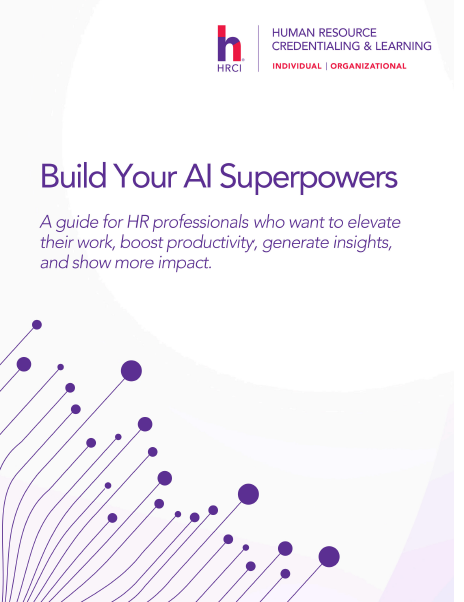
Over three-quarters of HR professionals use AI weekly, but most have had little to no training. Learn how to build real confidence and capability starting today.
Explore how HR can turn AI adoption into a strategic advantage—balancing innovation with ethical responsibility.
This research-backed guide gives HR professionals the data and practical steps to build a recovery-friendly culture that reduces risk and supports your people.
The report explores the realities of managing DEI programs in today’s climate—where values alignment, stakeholder trust, and business performance are all on the line.
This report provides critical insights and actionable strategies for HR leaders to foster a more harmonious and productive work environment.

HRCI webinars go beyond the basics. Each session unpacks the trends, data, and real-world strategies HR professionals need to lead with confidence today and adapt to what's coming next.
News and perspectives on the issues driving the HR profession forward.
The Equal Employment Opportunity Commission (EEOC) has released an updated Know Your Rights poster that employers need to post and make available to employees. The Department of Labor (DOL) has extended the comment period for the proposed independent contractor rule until December 13th. The Internal Revenue Service (IRS) has released various benefit plan contributions limits for 2023, the National Labor Relations Board has issued a proposed rule concerning fair choice and employee voice, and the Department of Homeland Security has notified employers that they should continue using the current I-9 form despite its expiration date of October 31, 2022.
EEOC Releases Updated Know Your Rights Poster – The Equal Employment Opportunity Commission (EEOC) has released an updated Know Your Rights poster. The updated poster replaces the EEO Is the Law poster. The poster includes information about discrimination based on race, color, sex, national origin, religion, age, disability, genetic information, and retaliation. According to the EEOC, the new poster, which is available currently in English and Spanish, with more languages anticipated in the future, includes these changes:
In conjunction with the EEOC, the US Department of Labor’s Office of Federal Contract Compliance (OFCCP) announced the release of the new Know Your Rights poster. Federal contractors have to use the “Know Your Rights” poster. Federal contractors are still required to post the Pay Transparency Nondiscrimination Provision and include it in employee handbooks and manuals. These documents advise applicants and employees of federal contractors of their rights that are protected by the OFCCP. Everyone needs to have a way to access the poster either electronically or physically.
DOL Extends Independent Contractor Comment Period – The US Department of Labor (DOL) announced that the comment period on its proposed independent contractor rule has been extended until December 13, 2022. Comments were due initially on November 28, 2022. When it published the proposed rule, DOL advised that it was designed to help employers classify workers and to address misclassification that occurs when workers are considered independent contractors rather than employees under the Fair Labor Standards Act (FLSA).
IRS Announces 2023 Benefit Plan Contribution Limits – The Internal Revenue Service (IRS) has announced the 2023 benefit plan contribution limits. The elective deferral limit for 401(k), 403(b), and 457 plans will increase to $22,500, a $2,000 increase from 2022. The catch-up contribution limit for those employees age 50 and over will jump by $1,000 to $7,500. The defined contribution plan annual contribution limit will be $66,000 as compared to $61,000 during 2022.
In 2023, the monthly limitation for the qualified transportation fringe benefit and the monthly limitation for qualified parking increases to $300, up $20 from the 2022 maximum. The limitation for employee salary reductions for contributions to health flexible spending arrangements (FSA) increases to $3,050, up from $2,850. For cafeteria plans that permit the carryover of unused amounts, the maximum carryover amount is $610, an increase of $40 from 2022. Health savings account (HSA) contribution limits will be $3,850 for self-only coverage (increase of $200) and $7,750 for family coverage (increase of $450).
NLRB Issues Fair Choice and Employee Voice Proposed Rule – The National Labor Relations Board (NLRB) has issued a proposed rule concerning election-blocking charges and voluntary recognition of unions. The proposed rule would rescind a rule adopted by the NLRB on April 1, 2020. Comments are due by January 3, 2023.
According to the NLRB, the rule that is now in effect allows representation elections to proceed despite pending unfair labor practice charges alleging coercive conduct that would interfere with employee free choice and potentially require the election to be re-run. The NLRB stated that the proposed rule would allow a Regional Director to delay a union election if “the conduct alleged threatens to interfere with employee free choice.” The NLRB believes that this would avoid conducting elections that might have to be re-run.
The NLRB also noted that the rule in effect allows challenges to the representative status of a union that has been voluntarily recognized before there has been a reasonable period for collective bargaining. The NLRB declared that “preventing challenges to the status of a newly recognized union until a reasonable period for collective bargaining has passed…better serves the policies of the National Labor Relations Act by vindicating employee free choice, encouraging collective bargaining, and preserving labor relations stability.”
Employers Should Continue Using the I-9 – The Department of Homeland Security (DHS) announced that employers should continue using the Form I-9, Employment Eligibility Verification after its expiration date of October 31, 2022. DHS advised that it publish a notice in the Federal Register once the new version of the Form I-9 is available.
Neil Reichenberg is the former executive director of the International Public Management Association for Human Resources. He is an attorney, a frequent writer and speaker on public policy and human resource issues, and an adjunct faculty member at George Mason University. For questions or additional information, contact Reichenberg at neilreichenberg@yahoo.com.