
The HRCI Research Hub brings together original studies, workforce polling, reports, and expert analysis, so you can act on what's happening now and prepare for what's next.
The State of HR Featured ReportsRecovery as a Workforce Strategy
Drawing on HRCI research, workforce data, and expert insight, this report examines the workplace impact of substance use disorder and the practical steps HR can take to strengthen culture, manager readiness, benefits, policies, and recovery support.
.png?sfvrsn=19b9ec76_1)
Original research and expert analysis on the issues shaping HR today, from workforce safety and emerging technology to DEI and employee well-being.
From return-to-office decisions and hybrid work to contractors and other non-traditional workers, this HRCI report explores the latest research and how HR can use data to make more informed, evidence-based workplace decisions.
From career paths to culture, this research identifies what actually separates HR professionals who are just getting by from those who are truly fulfilled—and what leaders can do to close that gap and build a more committed team.
This research uncovers where professional development is falling short, from misaligned training priorities to gaps in AI readiness, and what it takes to build a workforce equipped for what's next.
From bullying, political tension to substance use and violence prevention, this research covers workplace safety—what the data reveals, what's at stake, and what you can do to reduce risk and build a more resilient organization.
The State of HR
Based on HRCI’s survey of thousands of HR professionals, the State of HR report examines the issues defining the profession today. From AI and workplace culture to talent, leadership, and career growth, the report reveals how HR teams are adapting to change and preparing for the future. Explore the data, trends, and insights shaping the world of work below.
Download the Full ReportState of HR Spotlight Reports
Half of HR professionals work in environments marked by polarized viewpoints, and 4 in 10 describe their stress as extreme or high. Find out what the data reveals about conflict, mental health, and what it means for your organization.
HR professionals are broadly optimistic about their field — but over 4 in 10 are considering careers outside of it. Explore what's driving both the enthusiasm and the tension, and what it takes to build a team of true HR believers.
71% of HR professionals use AI regularly, yet more than half say implementing new technology is the area they feel least prepared to handle. See where the preparation gap is widest and what needs to change now.
83% of HR professionals believe remote work benefits organizations—but the debate is far from settled. Get the data on where HR stands on flexibility, productivity, and the return-to-office conversation.

More Insights for HR Professionals
Explore the issues shaping HR today and get the data you need to lead with confidence, make informed decisions, and move the profession forward.
Recovery friendly workplaces reduce absenteeism, improve retention, and strengthen workplace culture—yet most organizations haven't made meaningful progress. This HRCI and Fors Marsh research reveals why: stigma, undertrained HR teams, and weak leadership buy-in top the list. Understand where the gaps are and what organizations that get it right do differently.
Earning an HRCI certification builds earning power. Within four years, the median HRCI certificant earns 33% more than they did before getting certified. That's double the salary growth of comparable HR professionals over the same period. See what the data shows about the career and financial impact of HRCI certification.
HR is ready to lead, but is the organization ready to let it? This 2024 HRCI and MindEdge research report surfaces a striking disconnect: while 88% of HR professionals believe HR should drive business strategy, only half say leadership agrees. Add in underfunding, understaffing, and persistent burnout, and the case for rethinking HR's role has never been stronger.
AI is reshaping the workplace, and HR professionals are watching closely. This HRCI and MindEdge survey of HR practitioners reveals how the profession is navigating AI adoption, persistent burnout, rising turnover, and the evolving push and pull of remote work. Find out where your peers stand, and what the data means for the work you do every day.
Browse our complete library of research reports, guides, and frameworks. Whether you're building a business case, navigating a workforce challenge, or staying ahead of what's next, the intelligence you need is here.
From rising absenteeism to safety risks, HRCI research reveals how extreme weather is reshaping workforce management and what HR can do now.
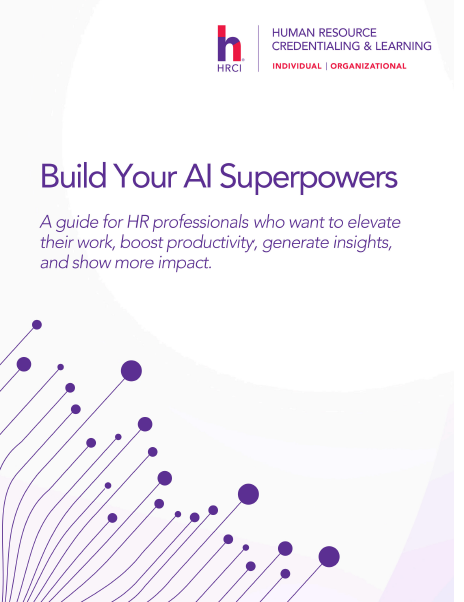
Over three-quarters of HR professionals use AI weekly, but most have had little to no training. Learn how to build real confidence and capability starting today.
Explore how HR can turn AI adoption into a strategic advantage—balancing innovation with ethical responsibility.
This research-backed guide gives HR professionals the data and practical steps to build a recovery-friendly culture that reduces risk and supports your people.
The report explores the realities of managing DEI programs in today’s climate—where values alignment, stakeholder trust, and business performance are all on the line.
This report provides critical insights and actionable strategies for HR leaders to foster a more harmonious and productive work environment.

HRCI webinars go beyond the basics. Each session unpacks the trends, data, and real-world strategies HR professionals need to lead with confidence today and adapt to what's coming next.
News and perspectives on the issues driving the HR profession forward.
There’s a growing wave of discontent with traditional performance management practices. In fact, a 2017 McKinsey Global Survey found that 54% of respondents said their performance reviews had no positive impact on performance. Some respondents found their organization’s performance management process to actually do more harm than good.
With numbers like this, teams and leaders in the HR space had to take notice.
“In the past, performance reviews were often treated as nothing more than a project to complete or an administrative task to check off,” says Jamie Resker, founder and practice leader at Employee Performance Solutions. “There was no mention of the value to employees or managers, or how the work was improving the performance of people in the organization.”
This attitude has shifted significantly in the past five years as organizations have begun to realize the immense value performance management can offer.
“The value of assessments lies in providing actionable advice,” says Mary Poffenroth, STEM faculty and innovation consultant at San Jose State University. “The main reason why organizations are moving away from the traditional one- or two-year assessment model is that it just looks back. The traditional models don’t actually offer opportunities for growth and development.”
Performance management is evolving rapidly. “The evolution of performance management is no longer a new concept,” Resker says. “The challenge is how to make the shift.”
Here are some performance management changes you can expect to see — and expect to stay.
The goals of performance management have shifted significantly in recent years, and the old process no longer supports them. Older methods of performance management relied on simply checking a box to determine pay scales. The process wasn’t leveraged to actually improve performance, which is the goal of modern performance management.
“Traditionally performance management has been a top-down process designed to serve HR’s needs, but contemporary performance management puts the employee at the center,” Resker says. “Employees are an organization’s largest stakeholders, so the system should benefit their needs and wants.”
Most employees, especially from younger generations, desire frequent feedback. “We use feedback in a classroom setting to help students move forward, and employees crave that same immediate response,” Poffenroth says. “It allows the employee to pivot in the moment, remember what they’ve done and apply the response immediately.”
Additionally, employees don’t know how they’re being “graded” if the consequences of their actions are discussed only once a year. Engaging in frequent feedback has been shown to be the most effective — and employee-desired — means of performance management because it connects actions with goals for the future.
To make the most of performance conversations, they must happen frequently. Psychologically, frequent feedback is far more effective than feedback that only happens on special occasions. “The annual review caused a lot of unnecessary anxiety and stress, which set both employees and managers up for failure,” Poffenroth says. “When humans are overwhelmed, we don't operate at our best. And the part of our brain that shuts down is the prefrontal cortex” — which is largely responsible for creativity.
“When we’re in that stressful space, we’re less likely to be creative, innovative or even to retain what's being said,” she says. Innovative solutions simply won’t come from reviews that are riddled with anxiety and so far removed from the actions they are purported to discuss.
Short, frequent check-ins — such as those pioneered at Netflix by Patty McCord — are much more likely to be effective in improving performance. “These frequent check-ins become an expected part of the company culture, so there’s so much less anxiety,” Poffenroth says. “It’s a huge shift, and it’s really powerful.”
Performance management is moving toward change and improvement, and a shift in culture toward frequent feedback sets the stage for success. “There’s a huge shift toward solutions that emphasize face-to-face performance development conversations that set employees and managers up for success, focus on what is working now and determine how to be even more effective moving forward,” Resker says. “This process emphasizes an open and fluid performance dialogue.”
Frequent feedback conversations should move away from the more formal and technical topics of the past and instead focus on bigger picture performance development goals. With the movement from performance management to performance improvement, feedback has the potential to increase performance-related business outcomes.
In the past, managers conducting performance reviews have simply checked some boxes at the end of the year — and then not thought about the topic again for 12 months. The shift to frequent feedback means managers have to be more involved in monitoring, responding to and collaborating on employee performance.
Training managers across departments to engage in these types of conversations is going to be a critical factor in the success of modern performance management. “We have to invest in building the skills and capabilities of both managers and employees to engage in conversations about performance and development,” Resker says. “These skills don’t come naturally to most, but they can absolutely be learned.”
Technology and automation are taking over many aspects of HR, but be cautious when leveraging these tools for performance management. “Beware of technology — including apps — that claim to automate performance feedback,” Resker says. “You simply can’t take the people and face-to-face conversations out of the equation.”
Technology can be used to great effect, however, to remind managers to engage in conversations, facilitate dialogue, record interactions, and make micro-learning, webinars or other materials on supporting interactions available as resources.
Furthermore, managers and employees will have questions about how ongoing performance conversations affect pay decisions. “Let people know that ‘salary administration’ will be a separate conversation that happens at a certain time during the year,” Resker says. “This helps people to transition from the review and rate mindset to the continuous conversation model.”
The goal of ongoing feedback is to improve performance, not determine pay. Performance conversations support annual pay decisions, but for best results they should be separated in the minds of employees. The ongoing conversation model of performance improvement is a critical step forward in your organization’s evolution of performance management.
This article was originally published in 2017 and was updated in October 2019.