


HRCI Research
Stay Informed

Lead with Data

The HRCI Research Hub brings together original studies, workforce polling, reports, and expert analysis, so you can act on what's happening now and prepare for what's next.

The State of HR Featured Reports
Featured Research

Recovery as a Workforce Strategy

Drawing on HRCI research, workforce data, and expert insight, this report examines the workplace impact of substance use disorder and the practical steps HR can take to strengthen culture, manager readiness, benefits, policies, and recovery support.

Recovery Strategy
Did You Know?
59%
Workplace Relationship Policies
say their company does not enforce policies prohibiting romantic relationships between employees
Source: HRCI Alchemizing HR poll, January 2025
89%
Leadership Overreach
say leaders take on problems that should belong to someone else
Source: HRCI Alchemizing HR webinar poll, April 2026
55%
Political Discussions at Work
of HR professionals are somewhat, minimally, or not at all prepared to handle politically-charged discussions at work
Source: HRCI Report — Managing Political Polarization in the Workplace, 2025
Recent Reports

Original research and expert analysis on the issues shaping HR today, from workforce safety and emerging technology to DEI and employee well-being.

Managing the Changing Workplace

From return-to-office decisions and hybrid work to contractors and other non-traditional workers, this HRCI report explores the latest research and how HR can use data to make more informed, evidence-based workplace decisions.

The Secret Ingredients of Workplace Fulfillment

From career paths to culture, this research identifies what actually separates HR professionals who are just getting by from those who are truly fulfilled—and what leaders can do to close that gap and build a more committed team.

The Vital Role of Professional Development

This research uncovers where professional development is falling short, from misaligned training priorities to gaps in AI readiness, and what it takes to build a workforce equipped for what's next.

Small Conflicts Don't Stay Small

From bullying, political tension to substance use and violence prevention, this research covers workplace safety—what the data reveals, what's at stake, and what you can do to reduce risk and build a more resilient organization.

The State of HR

The 2026 State of HR Report

Based on HRCI’s survey of thousands of HR professionals, the State of HR report examines the issues defining the profession today. From AI and workplace culture to talent, leadership, and career growth, the report reveals how HR teams are adapting to change and preparing for the future. Explore the data, trends, and insights shaping the world of work below.

Download the Full Report

State of HR Spotlight Reports

Safety, Polarization, and Stress

Half of HR professionals work in environments marked by polarized viewpoints, and 4 in 10 describe their stress as extreme or high. Find out what the data reveals about conflict, mental health, and what it means for your organization.

HR Professionals and Their Outlook for HR

HR professionals are broadly optimistic about their field — but over 4 in 10 are considering careers outside of it. Explore what's driving both the enthusiasm and the tension, and what it takes to build a team of true HR believers.

HR Professionals and Technological Change

71% of HR professionals use AI regularly, yet more than half say implementing new technology is the area they feel least prepared to handle. See where the preparation gap is widest and what needs to change now.

Attitudes Toward Remote Work

83% of HR professionals believe remote work benefits organizations—but the debate is far from settled. Get the data on where HR stands on flexibility, productivity, and the return-to-office conversation.

Professionals Problem Solving

More Insights for HR Professionals

Explore the issues shaping HR today and get the data you need to lead with confidence, make informed decisions, and move the profession forward.

Recovery friendly workplaces reduce absenteeism, improve retention, and strengthen workplace culture—yet most organizations haven't made meaningful progress. This HRCI and Fors Marsh research reveals why: stigma, undertrained HR teams, and weak leadership buy-in top the list. Understand where the gaps are and what organizations that get it right do differently. 

Earning an HRCI certification builds earning power. Within four years, the median HRCI certificant earns 33% more than they did before getting certified. That's double the salary growth of comparable HR professionals over the same period. See what the data shows about the career and financial impact of HRCI certification. 

HR is ready to lead, but is the organization ready to let it? This 2024 HRCI and MindEdge research report surfaces a striking disconnect: while 88% of HR professionals believe HR should drive business strategy, only half say leadership agrees. Add in underfunding, understaffing, and persistent burnout, and the case for rethinking HR's role has never been stronger. 

AI is reshaping the workplace, and HR professionals are watching closely. This HRCI and MindEdge survey of HR practitioners reveals how the profession is navigating AI adoption, persistent burnout, rising turnover, and the evolving push and pull of remote work. Find out where your peers stand, and what the data means for the work you do every day. 


Research Archive

Browse our complete library of research reports, guides, and frameworks. Whether you're building a business case, navigating a workforce challenge, or staying ahead of what's next, the intelligence you need is here.
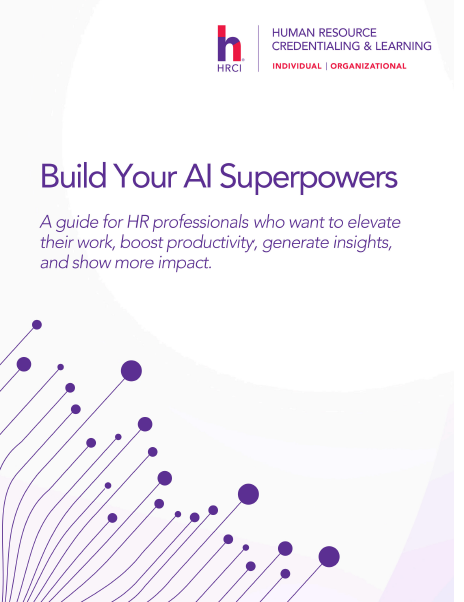
 

Ai Superpower
Extreme Weather and the Workplace

From rising absenteeism to safety risks, HRCI research reveals how extreme weather is reshaping workforce management and what HR can do now.

Ai Superpower
Strengthening AI Skills in HR

Over three-quarters of HR professionals use AI weekly, but most have had little to no training. Learn how to build real confidence and capability starting today.
Empowering the Intelligent Workplace

Explore how HR can turn AI adoption into a strategic advantage—balancing innovation with ethical responsibility.
Becoming Recovery-Friendly

This research-backed guide gives HR professionals the data and practical steps to build a recovery-friendly culture that reduces risk and supports your people.
Diversity Initiatives in 2025

The report explores the realities of managing DEI programs in today’s climate—where values alignment, stakeholder trust, and business performance are all on the line.
Managing Political Polarization in the Workplace

This report provides critical insights and actionable strategies for HR leaders to foster a more harmonious and productive work environment. 

Webinar online learning

Beyond the Data

HRCI webinars go beyond the basics. Each session unpacks the trends, data, and real-world strategies HR professionals need to lead with confidence today and adapt to what's coming next.


HR Leads Business Blog

News and perspectives on the issues driving the HR profession forward.

Feb 14, 2022, 20:49 PM by Barry Lawrence, HRCI Staff Writer

HR Must Embrace Culture and Accountability as a Strategic Process


Accountability is the key to innovative corporate culture. But at many organizations, accountability only comes up when something goes wrong. That's when the blame game kicks in and organizational goals get lost in the mix. HR professionals play a key role in championing the culture and accountability equation.


"Our experience proves that accountability, done the right way, produces greater transparency and openness, enhanced teamwork and trust, effective communication and dialogue, through execution and follow-through, sharper clarity, and a tighter focus on results," writes Roger Connors and Tom Smith in the bestselling book,  Change the Culture, Change the Game: The Breakthrough Strategy for Energizing Your Organization and Creating Accountability for Results. " Accountability should be the strongest thread that runs through the complex fabric of any organization."

However, companies remained largely challenged to create accountable and transparent organizations to more fluidly execute on strategies.  

Culture Eats Strategy for Lunch

"We've all heard that culture eats strategy for lunch," notes Mark Blankenship, Ph.D., the executive vice president and chief people, culture and corporate strategy officer for Jack in the Box Inc. Blankenship is one of 73 contributors to The Rise of HR, a compilation of HR thought leadership sponsored by HR Certification Institute® (HRCI®).  (The e-book is available for free download.)

He offers some key strategies for developing an accountable organization:

Have an organizational framework: The framework should capture not only what HR is directly responsible for but the entire organization's ecosystem, from strategy to stakeholders.

Jay Galbraith's Star Model is a great example of a framework that can be used Strategyto influence employee behavior. "One of the uses of the Star Model is to use it to overcome the negatives of any structural design," he said. "That is, every organizational structure option has positives and negatives associated with it.  If management can identify the negatives of its preferred option, the other policies around the Star Model can be designed to counter the negatives while achieving the positives."

Understand the power of culture: "The HR profession must have a keen sense of cultural alignment with his or her organization to help accelerate business/agility outcomes."

Have a competency/role framework. Don't just add HR value, add enterprise value.

Understand the role and leverage of leadership. HR must drive alignment, capabilities and engagement.

Have a measurement framework. Measure how the information connects to critical business performance.

Create and activate strategy. "In all of my years as an HR professional, this area is where most of the discontent arises from CHROs. Those who cannot connect strategic creation with activation are relegated to an activation role. This is where HR has been struggling to gain a seat at the table."

The Power of Accountability

 Accountability can't be mandated, but it can be encouraged. Josh Leibner a leadership consultant writing in Entrepreneur magazine, notes that a common mistake is made when companies ask people to own activities instead of outcomes. "You want people to stop paying attention to the amount of time they spend doing things and pay attention to the ultimate outcome desired," he writes.

In addition to clear strategies, roles and outcomes, Henry Browning, a senior faculty member at the Center for Creative Leadership, warns that it is extremely important not to view accountability as punishment.  Accountability needs to be built on trust, he writes in Forbes, with a focus on improvement.

"To that end, each person needs to honestly say what they know, what they thought and what they did (or didn't do)," Browning concludes. "One important thing you can do to support a learning atmosphere is to take a systems approach as well as holding individuals accountable. Seek to understand what aspects of the situation have influenced the process, system, culture or circumstances."

Building accountability in the workplace is not easy. For the HR manager, and the workforce, it takes courage and practice. But HR can play a significant role in making accountability an essential ingredient in the culture of business.